
When most people think of core strength, traditional abdominal exercises like crunches, sit-ups, and leg raises usually come to mind. These conventional movements primarily isolate a single superficial muscle group—the rectus abdominis—to create visible definition. However, true functional core strength involves much more than a visible six-pack.
The core is a complex 3D muscular system surrounding the entire midsection, including the deep abdominal walls, back extensors, diaphragm, pelvic floor, and hip stabilizers. Yoga offers a comprehensive approach to building functional core strength by targeting these deep, neglected stabilizing muscles while integrating breath work, multidirectional movement, and endurance holds.
Understanding the True Architecture of the Core
To understand why yoga is so effective for midsection strength, it helps to examine the functional anatomy of the core. Traditional exercises tend to focus heavily on spinal flexion, moving the torso forward and backward in a single plane of motion. Yoga targets the full anatomical structure of the midsection across multiple dimensions.
-
Transverse Abdominis: The deepest layer of abdominal muscle that wraps around the torso like a natural corset. It stabilizes the spine, supports internal organs, and maintains intra-abdominal pressure during movement.
-
Internal and External Obliques: Located along the sides of the torso, these muscles control rotational movements, side bending, and lateral stability.
-
Multifidus and Erector Spinae: Deep muscles along the spine that maintain alignment, support posture, and prevent lumbar strain.
-
Pelvic Floor and Diaphragm: The bottom and top boundaries of the abdominal cavity. Coordinated contraction of these muscular structures creates structural stability across the lower back and pelvis.
Functional Advantage of Isometric Holds and Asymmetry
Traditional ab workouts often rely on repetitive, high-volume movements that flex the spine repeatedly. While this can build endurance in superficial muscles, it often neglects deeper structural stabilizers and can place unnecessary strain on the lower back and neck.
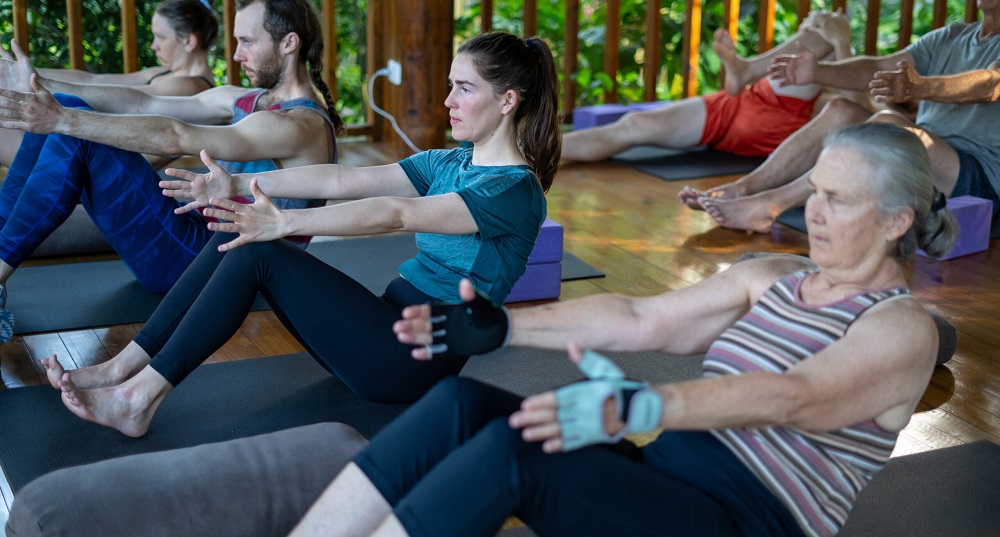
Yoga builds strength through isometric contractions—holding static postures under load. Holding poses like Plank (Kumbhakasana), Side Plank (Vasisthasana), or Boat Pose (Navasana) forces the core muscles to engage continuously to stabilize the weight of the body.
Isometric strength trains the core for its primary real-world purpose: resisting unwanted movement and stabilizing the spine against external forces.
Furthermore, many yoga postures introduce asymmetric loading and balance challenges. Standing poses such as Warrior III (Virabhadrasana III) or Revolved Half Moon (Parivrtta Ardha Chandrasana) force the body to balance on a single leg while extending the torso horizontally.
To prevent falling, deep stabilizing muscles fire rapidly in micro-adjustments. This reactive stabilization builds core control that simple two-legged crunches cannot replicate.
Multidirectional Movement and Spinal Health
A functional core must be strong through every range of motion, not just moving straight forward. Yoga routines naturally integrate four primary directions of spinal movement:
-
Spinal Extension (Backbends): Poses like Cobra (Bhujangasana) or Bridge (Setu Bandhasana) strengthen the posterior chain, including the glutes and spinal extensors, balancing out the forward-slumped posture caused by sitting at desks.
-
Lateral Flexion (Side Bends): Movements like Gate Pose (Parighasana) lengthen and strengthen the obliques and intercostal muscles along the ribs.
-
Spinal Rotation (Twists): Poses like Revolved Chair (Parivrtta Utkatasana) engage the internal and external obliques, increasing thoracic mobility and rotational strength.
-
Anti-Rotation and Anti-Extension (Stabilization): Positions like Bird-Dog or Forearm Plank train the midsection to resist sagging or twisting under pressure, protecting the intervertebral discs.
By moving the spine safely through all planes of movement, yoga develops balanced strength while preserving joint mobility and reducing the risk of lower back injuries.
The Role of Breath Control in Core Activation
One of the defining features that sets yoga apart from standard floor exercises is the integration of intentional breath work, or pranayama. Breathing is not merely an accessory to movement in yoga; it is an active mechanical component of core engagement.
Practicing three-dimensional diaphragmatic breathing and engaged core breathing (such as maintaining slight lower-abdominal engagement during inhalation) trains the diaphragm and pelvic floor to coordinate with the transverse abdominis.
When you exhale completely in poses like Crow Pose (Bakasana), the deep abdominals contract fully to expel air, deepening the muscular engagement. This continuous breath integration builds internal stability from the inside out, improving endurance and core pressure control during heavy daily lifting or athletic activities.
Key Yoga Poses for Deep Core Engagement
Integrating specific poses into a regular practice targets every layer of the core system effectively:
-
Forearm Plank (Phalakasana variant): Builds endurance in the transverse abdominis, shoulders, and glutes while preventing lumbar hyperextension.
-
Side Plank (Vasisthasana): Targets the obliques, quadratus lumborum, and lateral hip stabilizers, enhancing lateral stability.
-
Boat Pose (Navasana): Strengthens the hip flexors, deep rectus abdominis, and lower back extensors simultaneously.
-
Chair Pose (Utkatasana): Engages the entire core to support an upright spine while working the lower body.
-
Locust Pose (Salabhasana): Isolates the posterior core, strengthening the lower back, glutes, and upper back extensors to counteract poor posture.
Frequently Asked Questions
Can yoga replace traditional abdominal workouts completely?
Yes. A balanced yoga practice that incorporates planks, arm balances, standing stability poses, and backbends provides complete core strength, mobility, and stability without needing extra crunch-based routines.
How often should you practice yoga to build noticeable core strength?
Practicing dedicated yoga sessions three to four times per week for twenty to forty-five minutes produces noticeable improvements in core stability, posture, and strength within four to six weeks.
Is yoga safer for the lower back than crunches and sit-ups?
Generally, yes. Traditional sit-ups place high compressive loads on the lumbar spine during repetitive flexion. Yoga emphasizes neutral spine stability, isometric holds, and posterior strength, which usually protects and supports the lower back.
Do arm balances like Crow Pose require core strength or arm strength?
While arm strength is important, arm balances rely heavily on deep core engagement. The transverse abdominis and hip flexors must lift the lower body toward the torso, allowing the hands and shoulders to support weight safely.
Why do my core muscles shake during static yoga holds?
Shaking is a normal neuromuscular response. It indicates that motor units within the target muscles are fatiguing and calling on additional fibers to maintain the isometric contraction, which accelerates strength building.
How does core strength gained from yoga improve daily posture?
Yoga strengthens the deep transverse abdominis and spinal extensors while opening tight chest and hip muscles. This balanced strength holds the pelvis and spine in proper alignment effortlessly during sitting and standing.
Is dynamic flow or slow static holding better for core development?
Both offer unique benefits. Dynamic flows build functional endurance and coordination as you move between poses, while long static holds build deep isometric strength and mental stamina. Combining both styles yields optimal core development.